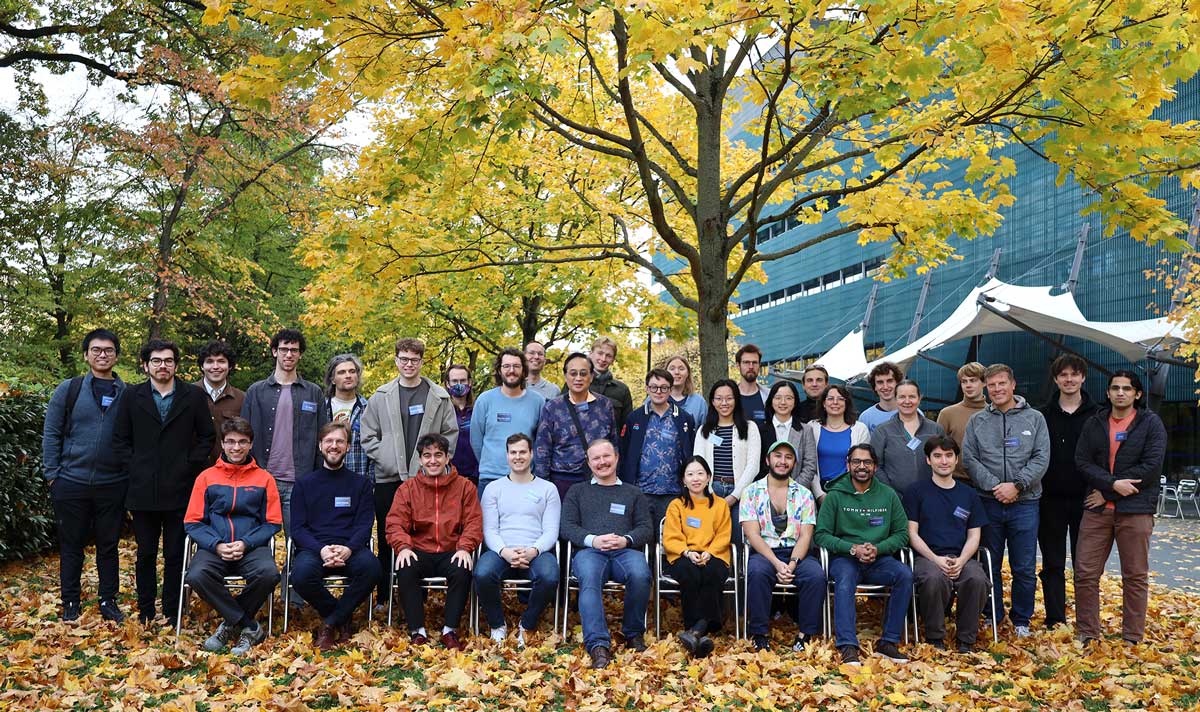
The Center for Systems Biology Dresden (CSBD) and the Max Planck Institute of Molecular Cell Biology and Genetics (MPI-CBG) hosted the Singular Learning Theory Days 2026 on October 26 and 27. The workshop brought together 45 researchers from the different communities that meet in singular learning theory — algebraic geometry and singularity theory, statistics, and machine learning — from eleven countries, including many early-career researchers.
Singular Learning Theory (SLT) is a mathematical framework developed by the Japanese mathematician Sumio Watanabe since the late 1990s; his 2009 monograph “Algebraic Geometry and Statistical Learning Theory” became the standard reference of the field. SLT studies how statistical models learn from data when they are singular, meaning that many different parameter values describe the same model, so that classical statistical theory no longer applies. Modern neural networks are singular in exactly this sense, which is why the theory has attracted growing interest in machine learning in recent years.
Besides bringing the singular learning theory community together, the meeting set out to clarify what SLT can contribute to present-day statistical and machine-learning practice, and which problems should shape the field over the next few years. A third aim was to draw researchers from algebraic geometry and singularity theory into the field: the central quantity of SLT, the learning coefficient, is an invariant of singularities, and several of the talks showed how tools from these areas can be used to compute it.
Sumio Watanabe (Institute of Science Tokyo) opened the workshop online with his talk “Singular Learning Theory: Foundations and Future Challenges.” Seven further invited talks traced the arc from theory to applications: Anne Frühbis-Krüger (University of Oldenburg) and Jules Tsukahara (Sorbonne University) spoke on the resolution of singularities and on the exact computation of learning coefficients, Kamillo Ferry (Imperial College London) on the singular geometry of fine-tuning large language models, Mathias Drton (TU Munich) on the singular Bayesian information criterion, Dan Bath (KU Leuven) and Simon Pepin Lehalleur (University of Duisburg-Essen) on Bernstein–Sato ideals and on jet schemes, and Edmund Lau (UK Department for Science, Innovation and Technology) on the role of learning theory in AI alignment. Between the talks, participants presented their own questions in three-minute flash talks, collected open problems on a “problem wall”, and chose which ones to pursue together in the closing open problem session.
The conference was organized by Jiayi Li (group of Heather Harrington), Maximilian Wiesmann (group of Aida Maraj and Ivo Sbalzarini), and Daniel Windisch (KU Leuven). They say:
This was the first edition of SLT Days, and we were really happy to see so many lively discussions between researchers from the different fields involved in singular learning theory. We are leaving with a list of open problems that participants have started to take up together and with a new mailing list for the community. We are very optimistic that these exchanges will lead to new collaborations and to insights beyond our current understanding of statistical processes and machine learning models and we hope these were not the last SLT Days.
The workshop was funded by the Max Planck Society, MPI-CBG and the German Research Foundation (DFG) through the Priority Programme SPP 2458 “Combinatorial Synergies.”