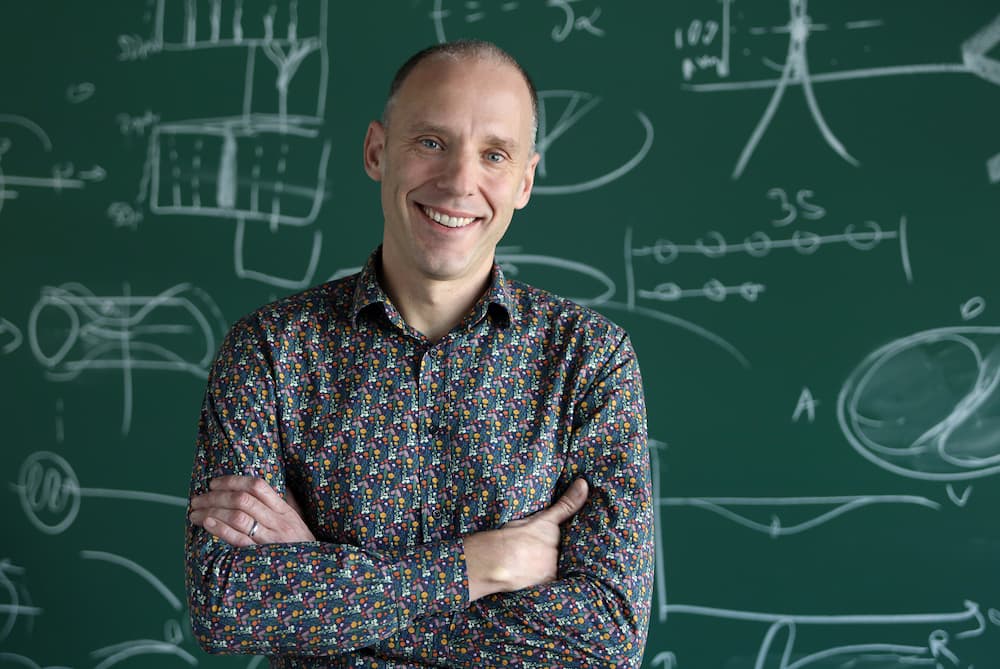
The European Research Council (ERC) announced the winners for their Advanced Grants today. The Advanced Grants give senior researchers the opportunity to pursue ambitious, curiosity-driven projects that could lead to major scientific breakthroughs. Stephan Grill, director at the Max Planck Institute of Molecular Cell Biology and Genetics (MPI-CBG), honorary professor at TU Dresden, and member of the TU Dresden Cluster of Excellence Physics of Life, is one of the 319 leading researchers across Europe who receive an 2026 ERC Advanced Grant with a total funding worth 838 million euros.
Stephan Grill receives 2.5 million euros of funds to pursue research on the ERC project “DNA Sequence-Dependent Structure Formation in the Cell Nucleus.” This project connects biology with physics and theory with experiment, aiming to build a physical theory of genome organization across scales. It will bring an understanding of how DNA sequences control structure formation processes inside the cell nucleus, with broad implications for development and disease.
Only about 1.5% of the human genome makes proteins. Stephan Grill explains, “The remaining 98.5% have been referred to as junk, but this DNA isn’t junk. Instead, it harbors the regulatory blueprint of life. It provides a landscape for the weak association of special proteins that act in concert to build larger assemblies. Where and how these assemblies form ultimately depends on the letter code of DNA, but how the sequence of letters controls the formation of larger architectures in the nucleus remains unclear. These architectures, however, are important; they structure the inside of the cell nucleus to allow the letters to be read out. Our interdisciplinary approach will shed new light on this old unsolved problem, shedding light on how our DNA works and how changes in DNA sequence might cause disease.”
In 2017, Stephan Grill already received an ERC Advanced Grant for his research project on “Chiral Morphogenesis,” and in 2011, he received an ERC Starting Grant.
Congratulations, Stephan!
The grants are part of the EU’s Horizon Europe programme. A record of 3,329 proposals was submitted to this competition, up 31% from 2,534 last year. 9.6% of proposals were selected for funding. Estimates show that the grants will create more than 3,000 jobs in the teams of new grantees. The new grantees will be based at universities and research centres in 24 EU Member States and associated countries, notably in the UK (62 grants), Germany (46), Switzerland (32), Spain (29), and France (26). Among the winners are 52 Germans, 45 Britons and 29 Italians, as well as researchers of 30 other nationalities.
Besides Stephan Grill, two other Saxon researchers also received an ERC Advanced Grant: Beate Escher (Helmholtz-Zentrum für Umweltforschung UFZ in Leipzig) and Anton Wallner (Helmholtz-Zentrum Dresden-Rossendorf).
Saxony's Science Minister Sebastian Gemkow congratulates,
Congratulations to the awardees on this tremendous success! Securing one of the EU’s most competitive research grants is a remarkable achievement. This award is not only a milestone in their individual scientific careers, but also a significant gain for Saxony as location for research.
Angela Rösen-Wolff, Vice Rector Research and Technology Transfer at TU Dresden, also shares her congratulations,
The ERC Advanced Grant awarded to Professor Stephan Grill is a tremendous recognition of his achievements, to which he has contributed for many years, including his work in the ‘Physics of Life’ Cluster of Excellence. I congratulate him on this great success.
About the ERC
The ERC, set up by the European Union in 2007, is the premier European funding organization for excellent frontier research. It funds creative researchers of any nationality and age to run projects based across Europe. The ERC offers four core grant schemes: Starting Grants, Consolidator Grants, Advanced Grants, and Synergy Grants. With its additional Proof of Concept Grant scheme, the ERC helps grantees to bridge the gap between their pioneering research and early phases of its commercialization. A new ERC Plus Grants scheme has been open for applications since June 2026.
Press Release of the Saxon State Ministry for Science, Culture and Tourism (in German)