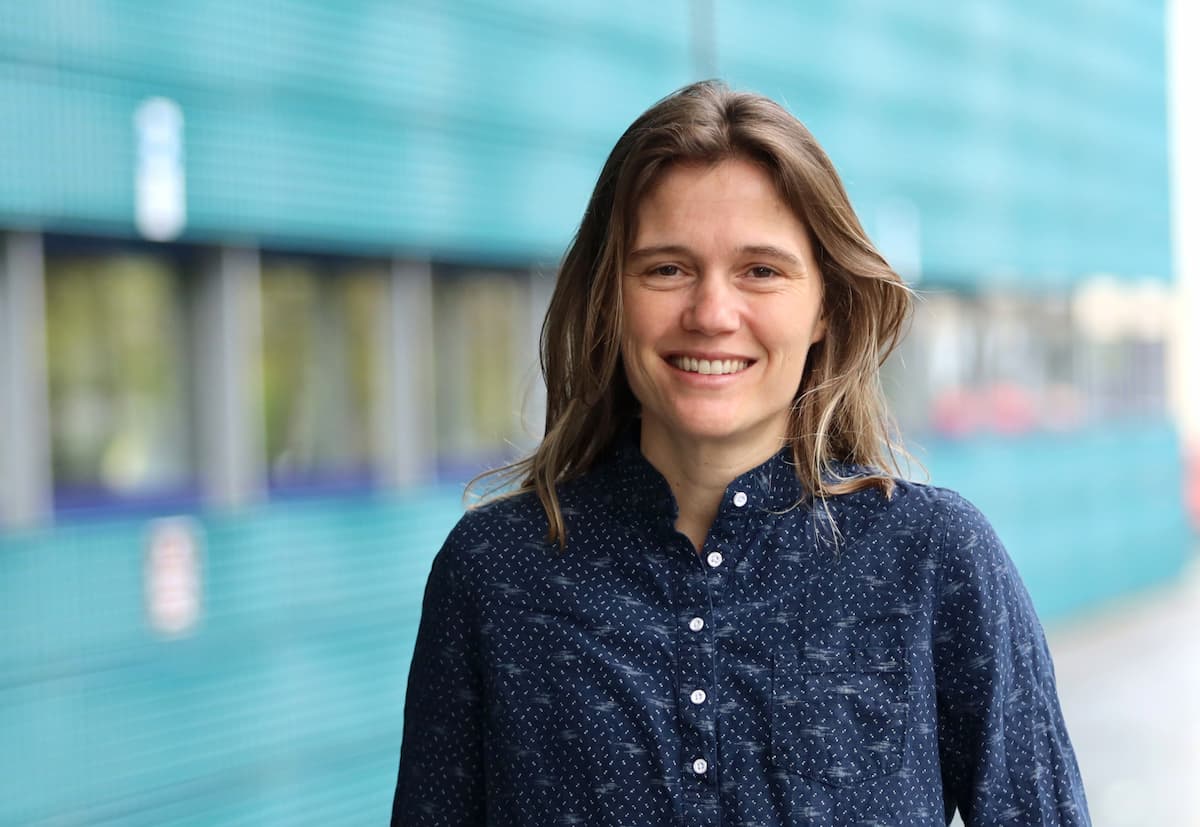
For a total of three months, the Max-Planck-Institute of Molecular Cell Biology and Genetics (MPI-CBG) and the Center for Systems Biology (CSBD) are hosting Oxford mathematician Maria Bruna as a visiting professor this summer. Maria is an Associate Professor and Royal Society University Research Fellow at the Mathematical Institute at the University of Oxford. In her research, Maria develops methods to model complex stochastic systems comprising a large number of interacting particles. “In essence, we try to simplify things,” Maria says. “Our goal is to describe the system at the population level using one or just a few equations.”
Maria is specifically interested in developing mathematical models for biological and industrial applications. In the past, she worked with the vacuum cleaner company Dyson Ltd. on how to optimize filters in air purifiers and vacuum cleaners. “In these filters, you have billions of fibers that interact with dust particles when dirty air flow goes through,” Maria explains. “Which also means you would need billions of equations to describe the system,” she adds. Maria’s team managed to break down this complex problem and derive an effective model of the filtration process, which allowed Dyson engineers to speed up the design and development time of optimized filters.
In Dresden, she wants to strengthen collaborations with groups working on biological problems. “Being among mathematicians all the time is honestly quite boring,” Maria says with a smirk. So far, she has been discussing project ideas with the groups of Stephan Grill and Heather Harrington.
In the past, she worked with entomologists to describe the collective traffic behavior of foraging ants. “And I really didn’t know anything about ants!” Maria admits. They discovered that some ants stop and act as dynamic obstacles, concentrating the traffic into narrower lanes to improve overall flow. “When we introduced pillars in the experiments, we observed the same effect,” Maria says. The findings could also inspire new strategies for managing pedestrian traffic in crowded environments.
Maria found her first month in Dresden in April already very stimulating. Now, she is eager to visit more labs and open to discussing biomedical and biophysical research questions where crowding or excluded-volume effects may be important. She is looking forward to connecting and collaborating with interested groups at MPI-CBG in June and July. “And I really don’t care whether it’s ants, proteins, or cells,” Maria says. “For me, they are all interacting particles!”