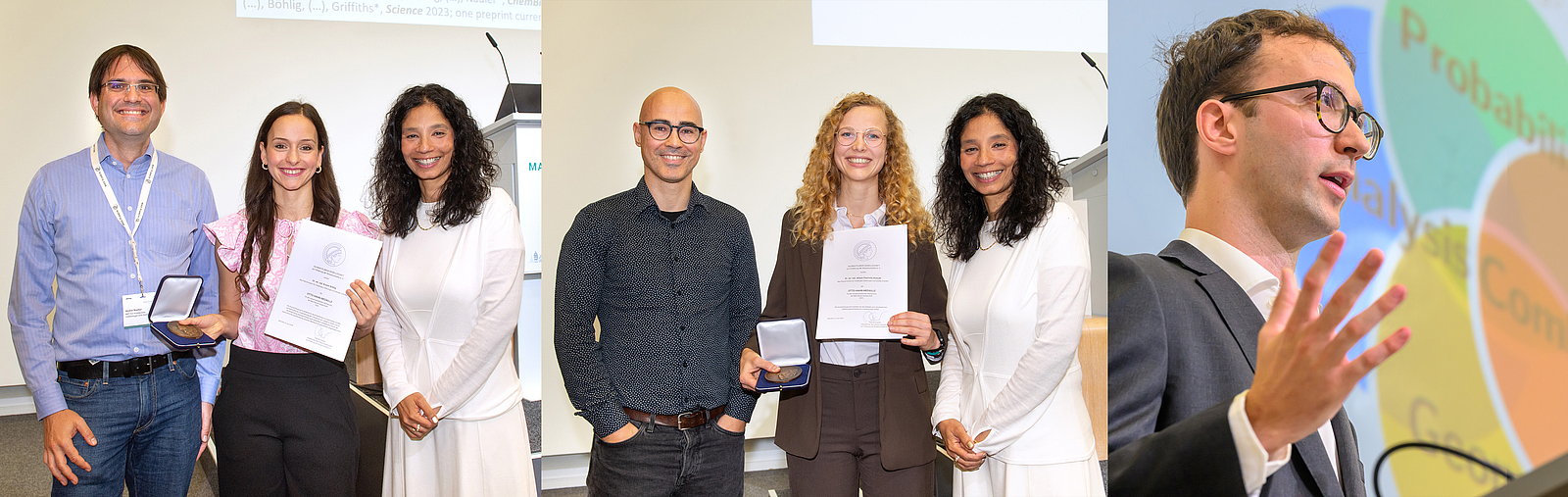
Every year since 1978, the Max Planck Society has awarded the Otto Hahn Medal to young researchers for outstanding scientific achievements, mostly in connection with their doctorate. The Otto Hahn Medal is endowed with 7,500 euros of prize money with the aim to motivate particularly talented individuals to pursue a university or research career.
Two awardees this year accomplished their PhD thesis at or in connection with the Max Planck Institute of Molecular Cell Biology and Genetics (MPI-CBG). One awardee is now researching at MPI-CBG and did his doctorate at the Max Planck Institute for Mathematics in the Sciences (MPI MIS) in Leipzig.
Kristin Böhlig, one of the awardees, did her PhD in the group of André Nadler at MPI-CBG. She receives the medal for her PhD thesis on “Diacyl and ether lipid probes for mechanistic analysis of lipid transport, metabolism and lipid-protein interactions.” Kristin says: “During my PhD, we developed a new technique to image single lipids in cells. Using a new chemical labeling strategy, we were able to see where specific lipids are located and how they are transported in cells. With the new imaging method, we were able to answer the question of how cells transport specific lipids to their target organelle membranes, and we could show that non-vesicular lipid transport by proteins is the primary mechanism that maintains the membrane composition of specific organelles. I am very grateful to receive the Otto Hahn Medal for my work and want to especially thank my supervisor, Dr. André Nadler, for his outstanding support and my colleagues for great teamwork during my PhD.” As next career step, Kristin works now as postdoctoral researcher at the Chair of Chemical Biology in the Faculty of Chemistry and Food Chemistry at TU Dresden.
Alison Kickuth, the second awardee, worked in the group of Jan Brugués, research group leader at the Cluster of Excellence Physics of Life at TU Dresden and fellow at MPI-CBG. For her PhD thesis on “The Physical Mechanism of Unilateral Cytokinesis,” Alison received one of this years’ Otto Hahn Medal. She says, “During my PhD, I found it fascinating how embryonic cells manage to divide reliably even when the geometry of life seems to work against them. I had the opportunity to use biophysical tools to investigate how an incomplete contractile ring, a temporary cellular structure that “pinches” a dividing cell into two daughter cells, can still drive cell division in early zebrafish embryos. We were able to uncover a mechanical ratchet mechanism, in which the cytoplasm alternates between stiff and fluid states, enabling a contractile ring without loose ends to progressively divide the cell. Our work solves a fundamental physical problem in vertebrate development.” Alison now works as a postdoctoral researcher in the MRC Laboratory of Molecular Biology (LMB) in Cambridge, UK.
Giulio Zucal, an ELBE postdoctoral fellow mentored by Türkü Özlüm Çelik and Stephan Grill at MPI-CBG and the Center for Systems Biology, also received an Otto Hahn Medal for his PhD work. He accomplished his thesis with the title “Continuous methods for discrete structures” at the Max Planck Institute for Mathematics in the Sciences (MPI MiS) in Leipzig. Giulio works in mathematics and its applications to biology and data science. In his PhD he developed rigorous mathematical tools to explore the structure and underlying geometry of networks, drawing on ideas at the intersection of the continuous and discrete worlds. At MPI-CBG his research focuses on random discrete structures, network dynamics, spectral hypergraph theory and the study of protein sequence space. “I would like to thank all the amazing people who helped me through my PhD journey: my family, friends, supervisors, mentors and collaborators. Their constant support, combined with the inspiring environment at MPI MiS, made this award possible,” says Giulio.
The medals were awarded on the occasion of the Annual Meeting of the Max Planck Society on June 17, 2026, in Frankfurt a. M.
Congratulations from all of us!
The Max Planck Society honors up to 30 young scientists and researchers each year with the Otto Hahn Medal for outstanding scientific achievements since 1978. The award is named after the German chemist and Nobel laureate Otto Hahn (1879–1968), who was president of the MPG from 1948 to 1960.