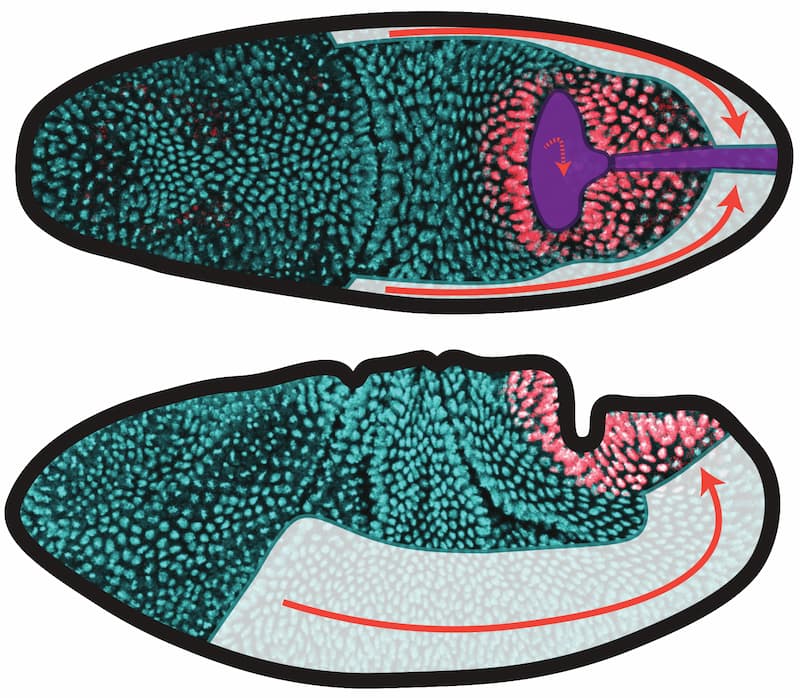
During tissue morphogenesis cells and tissues shape and organize themselves to form complex structures and organs. This process is crucial for the development and growth of organisms and is influenced by genetic, mechanical, and environmental factors. Morphogenesis often results from active biological processes generating forces within the tissue, but it can also be passive, with deformations resulting from forces imposed at their boundaries by neighboring tissues.
Shiheng Zhao and Pierre Haas from the Max Planck Institute for the Physics of Complex Systems (MPIPKS) and the Max Planck Institute of Molecular Cell Biology and Genetics (MPI-CBG), together with their experimental collaborators at Princeton University, USA, and the Flatiron Institute in New York, USA, have now developed a minimal mechanical model that explains the development of the hindgut of the fruit fly Drosophila melanogaster as an example of this passive morphogenesis.
Through their combined experimental and theoretical approaches, they found that the complex shape changes of the hindgut primordium—a group of cells that gives rise to the hindgut of the fly—can arise from mechanical forces applied by the surrounding tissues.
Daniel Alber from Princeton University and one of the lead authors of the study says, “The tissue is deformed by the surrounding tissues through a process called ‘mechanical coupling,’ whereby the mechanical forces applied by the surrounding tissues are transmitted to the hindgut primordium, causing it to change shape. Our findings suggest that its complex shape can be explained by simple mechanical principles, rather than complex genetic mechanisms.”
Shiheng Zhao, the other lead author, adds, “Pierre Haas and I created the minimal model that could calculate the mechanical forces and hence reproduce the deformation of the tissue not only in normal fly embryos, but also in different genetic perturbations.”
Pierre Haas and Stas Shvartsman summarize, “Our study has significant implications for understanding tissue morphogenesis and the development of organs and tissues in different organisms, by highlighting the role of inter-tissue mechanical couplings for the emergence of shape in development. Future studies will aim to uncover the molecular and cellular mechanisms that control this passive morphogenesis and its implications for tissue development and disease.”
Original Publication
Daniel S. Alber, Shiheng Zhao, Alexandre O. Jacinto, Eric F. Wieschaus, Stanislav Y. Shvartsman, and Pierre A. Haas: A model for boundary-driven tissue morphogenesis, PNAS, 18. September 2025, 122 (38) e2505160122
https://doi.org/10.1073/pnas.2505160122